
As the world progresses towards the ultimate goal of net-zero emissions, a new source of clean energy is emerging.
Geologic hydrogen is hydrogen that forms naturally underground through various geological processes.
Although millions of tons of hydrogen are already produced every year, the process used for this is costly and energy-intensive. This is why natural sources of hydrogen create excitement in the world of clean energy. Let's delve into how hydrogen forms naturally and is extracted.
Hydrogen Formation and Extraction
Large amounts of hydrogen are produced underground through various processes.
- One of these is serpentinization, a chemical reaction between water and iron-rich rocks at high temperatures that produces hydrogen. Serpentinization is fast and renewable, and produces large amounts of hydrogen.
- Another process is radiolysis, which occurs when there are radioactive elements present in rocks. The radiation interacts with groundwater and ancient brines, splitting the molecules of water to produce hydrogen. Unlike serpentinization, this process occurs much more slowly and is likely to occur where there are older rocks embedded deep within the Earth.
- Additionally, although controversial, some scientists have theorized that streams of hydrogen rise from the Earth’s core and mantle among tectonic plates and faults.
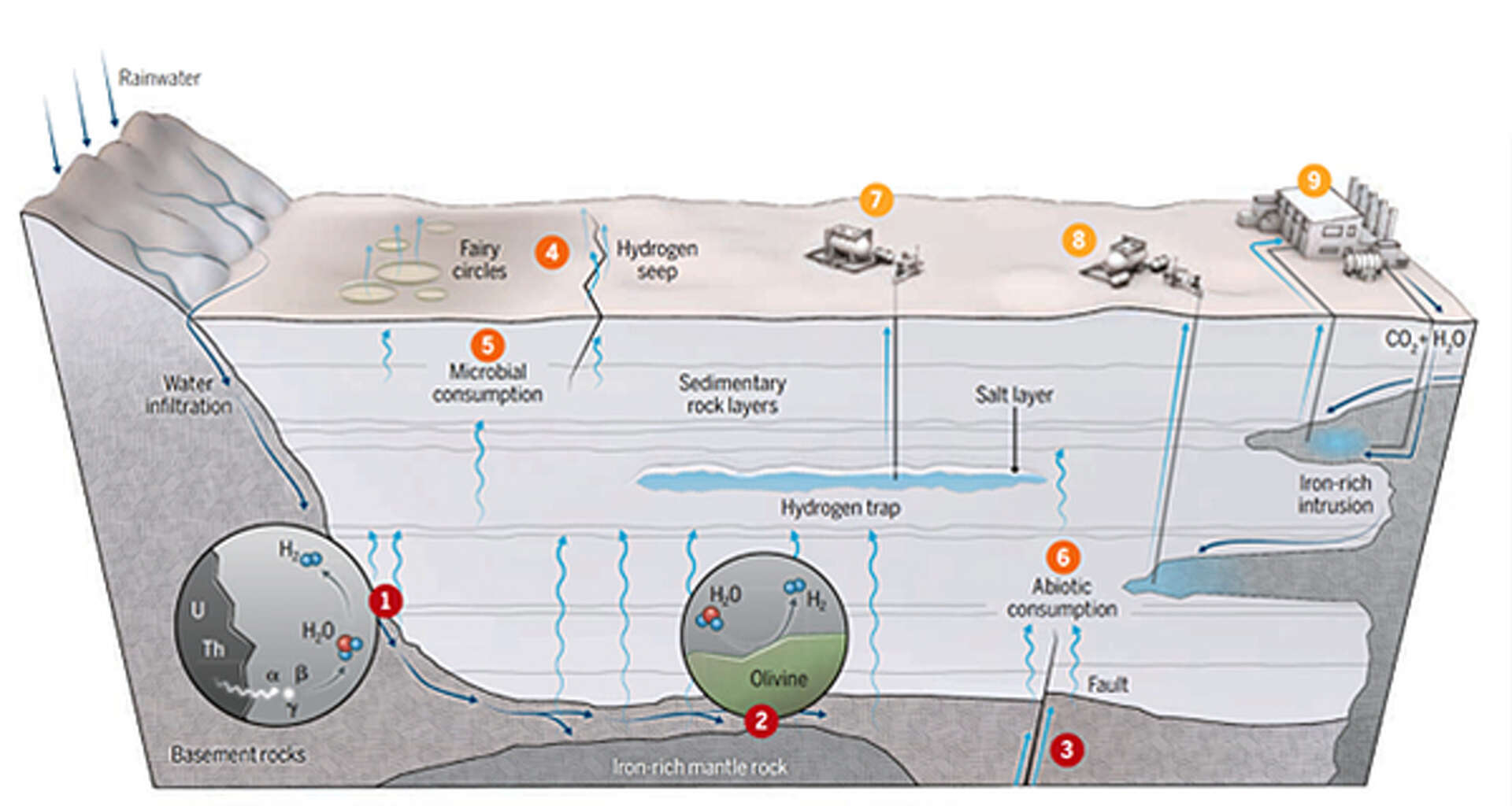
The hydrogen in these deposits can be extracted in multiple ways. The best method of extraction is natural accumulation, where hydrogen simply accumulates in reservoirs. Another method is stimulated accumulation, which occurs when hydrogen exists within rocks but doesn’t flow freely. In such cases, techniques like hydraulic fracturing are used to extract hydrogen.
Hydrogen can also be generated underground artificially by injecting water into reactive rocks to induce serpentinization -- this process is still under test.
Sites for Hydrogen Deposits

Recently, a study from the US Geological Survey identified Michigan as a potential source with large deposits of geological hydrogen. This is because underneath Michigan lies the Midcontinent Rift, a site where the continent of North America started splitting apart approximately a billion years ago.
Amongst the vast land the state covers, the edges of the state, where cities like Detroit are, have the deepest and oldest rocks with the highest likelihood of hydrogen deposits. There are also many more hydrogen-dense locations in Europe, Asia, and in African countries like Mali, where hydrogen has been extracted and used since the 1980s.
Hydrogen as Clean Energy
Once harnessed, hydrogen is a great source of energy because it releases zero carbon emissions when burned, unlike fossil fuels.
However, the same advantages don’t exist with mechanically produced hydrogen, which has high costs and is also energy-intensive. Instead, it uses more fossil fuels and contributes to climate change. Hydrogen can be especially useful in industries where electrification is difficult. For instance, the shipping industry.
Although exciting, there is a considerable amount of research to be done in this field. Scientists are still figuring out the exact locations of the embedded hydrogen and the work needed to harness it. Meanwhile, as the industry of geologic hydrogen progresses, we continue to inch forward in our journey to net-zero.
Sources: USGS, Grist, CATF